Sunday, December 03, 2006

is porn norm?


Is Porn Norm?
Rev. George C. Scipione
First published in Evangelium, Vol.3, Issue 4.

Several years ago, Faith Popcorn, America’s foremost trend expert, hailed by the New York Times as the “trend oracle” and as the “Nostradamus of marketing” by Fortune magazine, declared, “Porn is norm.” She was not endorsing pornography, but predicting that media technology would push the limits of what is acceptable and would facilitate a culture of instant gratification; thus porn would be the norm. True to her prediction, pornography has moved out of the back allies of the urban scene and onto the main streets of America.

While most Internet businesses were going bankrupt, the porn industry was raking in huge profits, making it perhaps the most profitable business on the Internet. In the past, one had to travel to sleazy backstreets to find porn; now, it’s only a click away on the computer and on the remote control of the cable/satellite TV. Easy, private and nobody knows … except God. At home or in the hotel, porn is private, available and acceptable. Some estimate that as much as 70% of in-room hotel profits come from porn and that over 50% of hotel patrons participate. As people consume it in private, porn becomes the norm and goes public.

Whether it’s the infamous Super Bowl incident or the recent Paris Hilton hamburger commercial, porn is seducing its way into the mainstream. The church needs to be on guard against this tsunami of trash. As it inundates our culture, it is also seeping into our churches. Shepherds must be vigilant and use the rod and staff to defeat this enemy and guard Christ’s sheep.

A Reality in the Church
I can hear you protest, “That’s the pagan world, not the church!” Are you sure? My personal experience and my pastoral experience have taught me otherwise. I’ve been ordained for over thirty years. I’ve served as pastor in two congregations, as a theological professor and as a biblical counselor. The threat is real, present and dangerous. It is much worse now than thirty years ago. While I do more counseling than most pastors, I have discovered that my experience is typical of dozens of other pastors, as I’ve talked with them, prayed with them and advised them on numerous cases.

Personally, on our home computer, spam (unsolicited mass e-mail) has included pornography pushing heterosexual sins, homosexuality, bestiality, and sadomasochism. Yes, ancient Rome would love this technological bonanza; Sodom would shout for joy as sin becomes so simple. Dear saints, we are slouching towards Gomorrah. As Professor Peter Jones has shown well, we have degenerated into a Roman Empire of pagan passions. (1)

As a pastor of a local congregation and a seminary professor, I’ve counseled pastors and members of evangelical and Reformed churches enslaved to porn—single and married men, men and women struggling with homosexuality, fornicators, adulterers, victims and perpetrators of sexual molestation, cross-dressers, transsexuals, and other unmentionable perversions. Porn, with the rare exception, is always involved. I have never dealt with a sex offender who was not deeply enslaved to porn. (2)

The Biblical Solution
To paraphrase a line from our history, “Heaven—we have a problem!” But we have a powerful, loving, sovereign Savior who rules and reigns in heaven! He has the answers to this dilemma and is more than willing to help us overcome the enemy of our souls and live pure, victorious lives in this evil and perverse generation (Phil 2:14-16). The solution is twofold. First, we must define these sins biblically. Second, we must biblically define God’s solution to these sins.

Porn, and the lusts triggered or deepened by it, are sins. But they are sins in specific ways. Such understanding is necessary to defeat these enemies. First, they are self-centered perversions of God’s design of human sexuality as part of the image of God and as a good gift to one’s spouse, (Gen 1, 2; 1 Cor 7). Second, they run contrary to reality and involve vain imaginations of the worst sort (Prov 17:24). Thus sexuality is depersonalized and degraded into mental and physical self-stimulation. Third, they involve coveting, a violation of the tenth Commandment (Eph 5:3-5). There are clear connections between sexual sins, coveting and idolatry. Lust, at the core, is worship of the creature instead of the Creator and the neglect of the good of others. The two great commandments are sacrificed on the altar of self-love. Thus, when a man turns to porn, he says at least three things: one, the Father’s love, the Son’s sacrifice and the Spirit’s fellowship are not enough; two, sexual love of spouse—present or future—is not enough; three, “I’m lord and king over me and can care for myself.”

On the one hand, the world’s view is that porn and lust are not serious problems, since, after all, “Everybody (almost) indulges.” On the other hand, our culture has little hope of change for sex offenders who engage in criminal behavior. But we Christians know better. The gospel of God’s free, sovereign grace through the life and death of Jesus the Messiah is the only effective answer to these sins.

What does the gospel say about these lusts? What would a pastoral approach to them look like? Is there any realistic hope for victory? Let’s try to summarize a biblical plan of care. I believe there must be at least the following seven things in a biblical pastoral plan that will result, LORD willing, in the renewal of a soul scorched by sexual sin: regeneration, renewed repentance and faith, a renewed mind, renewed obedience, regular use of various means of growing in grace, regular reporting to responsible shepherds, and reading good literature on these subjects. I address the issue of lust in men, but the same is true for women. Consider each one in sequential order.

REGENERATION: Jesus made it clear that the new birth is not optional, but absolutely essential. The unregenerate church member is incapable of producing the fruit of the Spirit as opposed to the deeds of the flesh (John 3:3-8; 15:4-5; Gal 5:16-26). If the disciple is a goat and not a sheep, chaff and not wheat, deep and lasting change is impossible. While a subjectively oriented inquisition is not helpful, a gentle probe can help. If Dr. C. John Miller had not probed my heart when I was in my first year of seminary, I might still be fighting a losing battle against my sins of the flesh, failing and on my way to a Christ-less eternity in hell! The pastor who is counseling should not try to be the Holy Spirit, of course; but he should ask questions and observe responses in ways that bring to light the true condition of the disciple’s heart.

RENEWED REPENTANCE AND FAITH: If there is evidence that the disciple is truly converted and he is a member in good standing of a Bible-believing church, then he must be renewed in his relationship with the Father through the Son by the power of the Spirit. Unless the brother can, to some extent, pray Psalm 51 with a straight face and heart, he is still trapped in sin and self-deception. Most believers caught in sin know they are wrong, just as David did. Yet it took the Spirit, using Nathan, for David to crack and repent (2 Sam 12:1-14). C. John Miller’s Repentance and the 21st Century Man is very helpful. Repentance is simply the flip side of the coin of faith. The brother must look to Christ for forgiveness in a fresh way (1 John 1:9-2:3). He must realize he is a new creature in Christ—justified, adopted, united with the Vine and sanctified (1 Cor 6:9-11; Heb 11-12).

RENEWED MIND: If the brother is to win, he must know his enemies—idolatry, covetousness, impurity. His mind must begin to perceive life in general and sexuality in particular in the light of God’s word (Eph 4:17-24, 5:3-21; 1 Tim 5:1-2). He has to see and respond as God’s adopted son, not as a pagan or an orphan.

RENEWED OBEDIENCE: He must understand the nature of covenant faithfulness and his part in progressive sanctification. This process is called mortification and vivification by the Puritans or “put off and put on” by Jay Adams. Adams’ works and those by Kris Lundgaard are helpful here. (3)

REGULAR USE OF VARIOUS MEANS OF GROWING IN GRACE: The disciple cannot win the battle while he is weak. Public worship including the preaching of the good news of God’s grace in Christ, the Lord’s Supper, prayer alone and with others, Bible reading, and fellowship with the saints is foundational to spiritual vitality.

REGULAR REPORTING TO RESPONSIBLE SHEPHERDS: This may be the most underused tool in the battle against these sins (Jas 5:13-18). Shepherding starts with the pulpit but must never end there (Matt 18:15-20; Luke 17:1-10). Someone must monitor the brother as a coach or trainer would (Gal 6:1-2). Accountability is essential. A man who will not submit to a shepherd whom he sees will not submit to a Shepherd that he does not see (1 John 4:20).

READING ABOUT THESE ISSUES: To ignore the wisdom of the elders of past generations and the developing classics of today is folly (Prov 1-9).

Conclusion
Jesus is exalted at the Father’s side and rules over all His enemies, including sexual sins. He is crowned, thus the victory is ours. On this “pagan planet,” in a crumbling culture saturated with sleazy sex, porn is norm. But for you, child of God, Christ is the norm and purity is possible. Don’t exchange your eternal inheritance and reward for some temporary sexual stimulation (Heb 12:16-17). Don’t be led like an ox to the satanic slaughterhouse (Prov 7:6-23). Keep your eyes fixed in faith upon Jesus and follow His footsteps to glory (Heb 12:1-2). (4)

FOOTNOTES

1 Jones, Peter, Capturing the Pagan Mind (Nashville: Broadman & Holman, 2003).

2 In addition, the Internet poses a problem for women as well. While not as drawn to porn as men, the Internet replaces the romantic or raunchy novel as a major polluter of women's hearts. I know of several instances of women leaving their husbands and children for a total stranger met online.

3 Lundgaard, Kris, The Enemy Within (Phillipsburg: P&R, 1998).
___, Through the Looking Glass (Phillipsburg: P&R, 2000).

4 Please refer to suggested references.


This article is not intended to be comprehensive due to the limits of space. For further information, here are some suggested references on this topic:

BOOKS
Harris, Josh, Not Even a Hint (Sisters: Multnomah, 2003).
Wilson, Doug, Fidelity (Moscow: Canon Press, 1999).
Hall, Laurie, An Affair of the Mind (Colorado Springs: Focus on the Family, 1996).
Journal of Biblical Counseling, Vol. 13, No. 3 (available at Christian Counseling & Educational Foundation, www.ccef.org).

AUDIO
"The Pain of Porn" by Jim Newheiser, # ibc0111
"Purifying the Heart of Sexual Idolatry" by John Street, # ibc0314
(These can be ordered from www.soundword.com)

Ó2006 Westminster Seminary California All rights reserved

Permissions: You are permitted to reproduce and distribute this material in any format provided that you do NOT alter the wording in any way and you do not charge a fee beyond the cost of reproduction. For web posting, a link to this document on our website is preferred. Any distributed copy must contain the following statement: By [author's full name] © [date] Westminster Seminary California.
Website: www.wscal.edu. E-mail: mail@wscal.edu. Phone: 760.480.8474

For Evangelium articles, the reproduced copy must contain: "First published in Evangelium, Vol. 3, Issue 1 (Jan/Feb 2005)."

Friday, December 01, 2006

is the law of moses timeless?


Some reformed say yes, some say no.

Here's a quote from Dr. Greg Bahnsen on the former view:

"When God promulgated His moral will through the Mosaic law, how much of mankind did He consider accountable to keep that law? From Paul's standpoint the answer was obvious: "Now we know that whatever things the law says, it says to those who are under the law, so that every mouth may be stopped and all the world may be brought under the judgment of God" (Romans 3:19). God declared His righteous standards to Israel, and through Israel to all the world, thereby stopping every mouth and bringing all men, Jew and Gentile alike, under judgment. "Whatever things the law says," therefore, it says to the whole of mankind. Precisely for this reason Paul could "lay to the charge both of Jews and Greeks that they are all under sin.... There is no distinction, for all have sinned and fall short of the glory of God" (vv. 11, 23)." Read More

Here's a quote from Lee Irons on the latter view:

"In Paul's normal usage, nomos means the Mosaic Law as a covenant of works. As such the Mosaic Law includes all of the stipulations given to Israel through Moses, founded on the "Do this and live" principle, accompanied by the threat of the curse for those who transgress the Law. The sanctions of the Law (blessing and curse) cannot be separated from the stipulations of the Law because the two are inextricably intertwined. Believers have been set free from the Law by means of their union with Christ in his death. The Law has jurisdiction over a person only as long as he is alive (Rom. 7:1; Gal. 2:19). Because we have died with Christ, we are "not under law" (Rom. 6:14-15; 7:4-6; 1 Cor. 9:20; Gal. 3:23-25; 4:4-5, 21; 5:18). This means we are free from its condemnation and from its commanding authority."Read More


Thoughts?

Wednesday, November 29, 2006

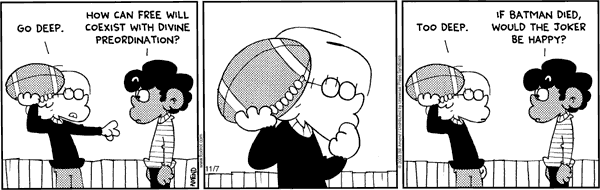
go deep

Monday, November 20, 2006

this is the gospel!


Thus faith links us to Christ and receives all that he has to give us. Through faith in Jesus our sin is imputed to him so that he pays for these sins on the cross and through that same faith his righteousness (his merits and holy works) becomes ours. This is what we mean when we speak of being justified by grace alone through faith alone on account of Christ alone. This is the gospel! God freely gives in Christ what he demands of us under the law. And if we are not clear about this, we have no foundation for living the Christian life, no assurance of our salvation, and we have nothing left to confess to the unbelieving world around us. - Kim Riddlebarger

Monday, November 13, 2006

what is true spirituality?


"...true spirituality is an on-going, moment by moment trusting in Christ and his word. It is a thankful trust sustained by the realization that the shed blood of Christ provides for us completely; for our sanctification now as much as for our salvation which is still to come in its fullness. It is also an applied trust, a living by faith as though we were already dead and a stepping out into the external world as though we were already raised from the dead; and it is a transforming trust, a trust that testifies to the real forgiveness of sins and manifests the fruit of the indwelling Spirit."

- Mark Ryan, commenting on the "beating heart" of Francis Schaeffer's theology

Saturday, November 11, 2006

true perfection is imperfect


Romans 7:25 I thank God through Jesus Christ our Lord. So then with the mind I myself serve the law of God; but with the flesh the law of sin.

- He recovers himself, and shows us that he rests only in Christ.
- This is the true perfection of those that are born again, to confess that they are imperfect.

(from the 1599 Geneva Bible)

Thursday, November 02, 2006

love that never quits


"I am the Lord, I change not."
— Malachi 3:6

He is unchanged in His love. He has loved His people with "an everlasting love"; He loves them now as much as ever He did, and when all earthly things shall have melted in the last conflagration, His love will still wear the dew of its youth. Precious is the assurance that He changes not! The wheel of providence revolves, but its axle is eternal love. - C.H. Spurgeon

Tuesday, October 24, 2006

a tulip in the psalms


Psalm 65: 3,4

"When iniquities prevail against me, you atone for our transgressions. Blessed is the one you choose and bring near, to dwell in your courts! We shall be satisfied with the goodness of your house, the holiness of your temple!"

T = "When INIQUITIES PREVAIL against me..."
U = "Blessed is the one YOU CHOOSE"
L = "...the ONE you choose"
I = "...and BRING NEAR"
P = "We SHALL BE SATISFIED with the goodness of your house"

Sure, there are more clear verses in scripture that point us to the wonderful truths of God's salvation, but once you are convinced of these, then your eyes are opened to see the more subtle verses that echo His unbelievable love.

key: T (total depravity) U (unconditional election) L (limited atonement) I (irrisistable grace) P (perseverance of the saints)

Tuesday, October 17, 2006

a quote worth remembering


"Alot of what Job's friends said could be put on a coffee cup and sold in a Christian bookstore." - Michael Horton

Here mp3's of OKC Conference on Reformed Theology "Too Good to be True: Finding Hope in a World of Hype" with Dr. Michael Horton

Friday, October 13, 2006

faith is hard


"Our opponents regard faith as an easy thing, but I know from personal experience how hard it is to believe. That the Holy Ghost is received by faith, is quickly said, but not so quickly done.

All believers experience this difficulty. They would gladly embrace the Word with a full faith, but the flesh deters them. You see, our reason always thinks it is too easy and cheap to have righteousness, the Holy Spirit, and life everlasting by the mere hearing of the Gospel" - Martin Luther

Thursday, October 12, 2006

zealous for good works


"[He] gave himself for us to redeem us from all lawlessness and to purify for himself a people for his own possession who are zealous for good works." - Titus 2:14

"At the heart of Christianity is the truth that we are forgiven and accepted by God, not because we have done good works, but to make us able and zealous to do them. The Bible says, "[God] saved us... not because of our works" (2 Timothy 1:9). Good deeds are not the foundation of our acceptance, but the fruit of it. Christ suffered and died not because we presented to him good works, but he died "to purify for himself a people... zealous for good works".

"Zeal means passion. Christ did not die to make good works merely possible or to produce a half-hearted pursuit. He died to produce in us a PASSION for good deeds. Christian purity is not the mere avoidance of evil, but the pursuit of good."

- John Piper, from Fifty Reasons Why Jesus Came To Die

Tuesday, October 10, 2006

death and the gospel


"...let us never forget that the gospel is for Christians too. We need to hear the word preached to us, whether from the pulpit on a Sunday or in conversation with other believers. If a brother or sister is mourning, then let us not simply tell them that the death of their loved one is all within the will of God; let us not even stop with simply feeling compassion and sympathy for them; let us also point them to the Lord Jesus Christ who rose from the dead.

Death is an outrage, an illegitimate boundary; it is nasty and brutish; but the captain of our salvation has burst through that boundary and come out on the other side. He is risen from the grave; and in his resurrection we see that, though we live in a vale of tears and agony here and now, where death seems to hold all the trump cards, there is a day most certainly coming when we know that we too, and all the loved ones who have gone before us in Christ, will rise to be with Christ. His death was agonizing but it could not hold him; ours will no doubt be terrible and traumatic; but because of Christ, death will not hold us either. " - Carl Truman

Saturday, September 23, 2006

the swiss army verse


"For by a single offering he has perfected for all time those who are being sanctified." - Hebrews 10:14

There are some verses in the bible that are so packed full of meaning and significance, so as to cause one to read and re-read them for a period of time. Bye the way, this is a great definition of "biblical meditation". The above verse is one such example. Read it again carefully.

Consider how many false ideas this verse demolishes. It's like a swiss army knife, it has a tool for everything you could possibly need.

Just a small number of things this verse clears up for the believer:
1. We know Christ's sacrifice was final and complete.
2. He didn't do a half-way job, it was a perfect sacrifice. We can add nothing to it.
3. It covers all sin past, present and future.
4. It points to limited atonement; Christ died for His people.
5. It points us to perseverance; He will complete what He started.
6. It assures us of eternal security being linked to the cross.
7. It affirms, not a sinless life for the believer, but a perfect position before God based on His substitution for us.

any more thoughts?

Wednesday, September 20, 2006

no strings attached?


Everybody needs to have some understanding of predestination since it’s in the Bible.

The dictionary says that “predestinate” means, “to foreordain to an earthly or eternal lot or destiny by divine decree.” Or, in simpler terms predestination means, “God’s decision as to what will happen to a person, especially after they die (heaven or hell).”

There are two basic responses to the idea of predestination:
1. God makes His choice based on his foreknowledge. This means that God (who is omniscient) chooses those He saw from the beginning who would choose God, have faith and follow Christ.

2. From all eternity God decided to save some members of the human race and to let the rest of the human race perish. God made a choice – He chose some individuals to be saved unto everlasting blessedness in heaven, and He chose others to pass over, allowing them to suffer the consequences of their sins, eternal punishment in hell. He chooses based on His good pleasure who will receive grace and who will not. Those that He gives grace, are changed. They desire God and receive the gift of faith and salvation.

- R.C. Sproul

Read More

Friday, September 15, 2006

Hermen E. Utics


...No, it's not a nerdly guy, it's how to read the bible!

“By referring to the gospel as the hermeneutical key I mean that proper interpretation of any part of the Bible requires us to relate it to the person and work of Jesus. This was recognized in Article III of the Chicago Statement on Biblical Hermeneutics, which says, ‘We affirm that the Person and work of Jesus Christ are the central focus of the entire Bible.’ We have already considered some of the ramifications of Jesus’ post-resurrection claims that all the Scriptures are about him. This is another way of saying that Jesus is the sole mediator of the truth of God. This mediatorial role has great significance for how we understand the Bible. For there is one God; there is also one mediator between God and humankind, Christ Jesus, himself human who gave himself a ransom for all (1 Timothy 2:5-6). The Jesus who mediates the word of God to us is the Jesus who is defined in terms of his historic saving act. The meaning of the Bible, in that case, is tied to the saving work of Jesus
(Graeme Goldsworthy, Preaching the Whole Bible as Christian Scripture, p. 84).

Monday, September 11, 2006

on weekly communion


"Perhaps the idea of coming to the Table weekly is troubling, but why? The most common argument against weekly celebration of the Supper is that it might become routine. Doubtless this is a danger, but by this rationale all churches should hold only monthly worship services so that the sermons and singing will be truly meaningful. The absurdity of the argument is obvious. The possibility of abuse is no excuse for not making use of the divinely instituted means of grace.

Perhaps there is a more fundamental reason we are reluctant to observe the Supper more regularly. One fears that the simple gospel message of Christ offered for and to sinners is not really on the evangelical agenda—or credenda for that matter. (Agenda is Latin for “things to do,” and credenda is Latin for “things to believe.”) It might be that regular observance of the Supper would require a transformation of most evangelical worship services. It is difficult to imagine how a solemnly joyful service of the Supper would fit into some “seeker sensitive” services.

Weekly Communion would also affect the preaching by tending to orient the service around Christ’s finished work and away from the constant diet of “how to” messages. The juxtaposition of “Ten Steps to a Happy Marriage” followed by a Communion service is too jarring to contemplate. Simply considering a weekly Communion a hypothetical possibility in our time seems to present radical challenges to evangelical piety." - R. Scott Clark

a bittersweet sojourn


The Christian life is one of constant repentance over sin and constant clinging to Christ's bloody, nail-driven hands; sorrow and bliss walk hand in hand with us on our earthly sojourn, until sorrow finally departs on that glorious day when our beautiful Redeemer returns!

faith comes by hearing, not fads


What’s the difference between the latest, greatest religious attraction at the stadium and an ordinary service at your local church, where the Word is properly preached and the sacraments are properly administered? In one, the religious ego is fed; we hear the hype and come to believe – or, at least, to hope – that after having tried so many other spiritual fads, at least this one will do the trick. We’ll raise ourselves from earth to heaven, from blahs to bliss, from strain to living at the center of God’s blessing.

read more

Wednesday, September 06, 2006

humility


"When a certain rhetorician was asked what was the chief rule in eloquence, he replied, 'Delivery'; what was the second rule, 'Delivery'; what was the third rule, 'Delivery'; so if you ask me concerning the precepts of the Christian religion, first, second and third, and always I would answer, 'Humility'. - Augustine

Friday, September 01, 2006

are you a deiphobe?


"Even the Christian must fear God. But it is another kind of fear. It is a fear rather of what might have been than of what is; it is a fear of what would come were we not in Christ. Without such fear there can be no true love; for love of the Saviour is proportioned to one’s horror of that from which man has been saved. And how strong are the lives that are suffused with such a love! They are lives brave, not because the realities of life have been ignored, but because they have first been faced — lives that are founded upon the solid foundation of God’s grace. May such lives be ours!" - J. Gresham Machen

Thursday, August 31, 2006

calvinism


Well can I remember the manner in which I learned the doctrines of grace in a single instant. ... I can recall the very day and hour when first I received those truths in my own soul when they were, as John Bunyan says, burnt into my heart as with a hot iron, and I can recollect how I felt that I had grown on a sudden from a babe into a man that had made progress in Scriptural knowledge, through having found, once for all, the clue to the truth of God. - C.H. SPURGEON

faith is a gift


"Faith is a gift from God, so that no one may boast ... The last bastion of pride is the belief that we are the originators of our faith ... This teaching about faith being a gift of God raises many questions. God has answers for all of them, even if we don't. Let us seek to put the teaching into practical biblical use, namely the humbling of our pride and the stimulation of our prayers. In other words, let us pray daily: "O Lord, thank you for my faith. Sustain it, Strengthen it. Deepen it. Don't let it fail. " - John Piper

Friday, August 25, 2006

Jesus, the temple


"Jesus answered them, 'Destroy this temple, and in three days I will raise it up.' The Jews then said, 'It has taken forty-six years to build this temple, and will you raise it up in three days?' But he was speaking about the temple of his body."
-John 2:19-21 (ESV)

" 'Kill me, and I will become the global meeting place with God.' That's the way I would paraphrase John 2:19-21. They thought Jesus was referring to the temple in Jerusalem: 'Destroy this temple, and in three days I will raise it up.' But He was referring to His body. Why did Jesus draw the connection between the Jewish temple and his own body? Because he came to take the place of the temple as the meeting place with God...' 'Where we meet him, we meet God.' "

- John Piper, Fifty Reasons Why Jesus Came to Die

Wednesday, August 23, 2006

how do law and faith relate?


"...faith alone makes someone just and fulfills the law; faith it is that brings the Holy Spirit through the merits of Christ. The Spirit, in turn, renders the heart glad and free, as the law demands. Then good works proceed from faith itself. That is what Paul means in chapter 3 when, after he has thrown out the works of the law, he sounds as though the wants to abolish the law by faith. No, he says, we uphold the law through faith, i.e. we fulfill it through faith." - Martin Luther, Intro to Romans

Tuesday, August 22, 2006

keep your eyes on Jesus


It's so important to keep our eyes on Jesus, the author and perfector of our faith. But what does that mean? Here are but a few thoughts:
-We must focus our eyes on Jesus' intrinsic righteousness (He is Holy and completely pleasing to the Father)
-His perfect life (lived for us)
-His sufferings (taken for us)
-His Kingship (ruling over us)
-His humanity (representing us)
-His deity (guiding us)
-His compassion (caring for us)
-His righteous anger (eradicating sin for us)
-His shepherd heart (feeding us)

Any others?

Friday, August 18, 2006

was there a "church" in the old testament?


Dispensational and New Covenant theology say NO. Covenant theology says YES.

Herman Ridderbos speaking on Matthew 16:13-20: "We should note that this is the first and, besides 18:17, the only time that Jesus spoke of His church in the Gospels. He apparently was alluding to the time when the disciples would carry on His work in His name. He referred to the future fellowship of believers with a word that corresponds to the name that had been given to ancient Israel as a religious community (Hebrew: qahal). Commentators have argued for a variety of reasons that Jesus could not have spoken of such a future organization at this stage of His life. Thus they think that the statement was not Jesus’ own but was put back into His mouth later by the church. Such a glance into the future is not at all surprising at this point, however, since the gospel here is taking a distinct turn toward the end of Jesus’ life. What is more, Jesus did not speak of an organized church. He was merely alluding to the future community of those who would believe in Him. In view of what He said elsewhere about "fishers of men" (4:19), about His "sheep" (John 10:15; 21:15) and his "flock" (John 10:16), and in view of the close circle of disciples that He had gathered around Himself, His notion of such a community cannot be considered anachronistic.

By calling this community His church, He designates it as the people of the Messiah, the community that would replace Israel as the people of God. Jesus had more to say about this future church: `the gates of Hades will not overcome it’ . . . . The church of Christ . . . will not be overcome by this power of death. Jesus spoke here as one who was stronger than death and who would cause His church to share in His victory over it." [See Herman Ridderbos, Matthew: Bible Student’s Commentary, trans Ray Togtman (Grand Rapids, Zondervan, 1987), 304].

While the church is clearly a new covenant institution [Cf. Meredith Kline, The Structure of Biblical Authority (Grand Rapids: Eerdmans, 1981), 193], Jesus’ use of the word qahal clearly indicates a continuity with the Old Testament people of God. The connection then is eschatological and covenantal [see Donald A. Hagner, Matthew 14-28: Word Biblical Commentary, Vol. 33b (Dallas, Word Books, 1995), 471].

Now, would I be emphatic about this point? Not too much, but it is important to realize - whichever side of the fence you're on - that God's elect throughout history have always been save by grace, through faith in the historical Messiah.

See a comparison of these 3 systems: Disp, NCT and CT

indwelling sin


It is a doctrine, as I believe, taught us in Holy Writ, that when a man is saved by divine grace, he is not wholly cleansed from the corruption of his heart. When we believe in Jesus Christ all our sins are pardoned; yet the power of sin, albeit that it is weakened and kept under by the dominion of the new-born nature which God doth infuse into our souls, doth not cease, but still tarrieth in us, and will do so to our dying day.

It is a doctrine held by all the orthodox, that there dwelleth still in the regenerate, the lusts of the flesh, and that there doth still remain in the hearts of those who are converted by God's mercy, the evil of carnal nature. I have found it very difficult to distinguish, in experimental matters, concerning sin. It is usual with many writers, especially with hymn writers, to confound the two natures of a Christian. Now, I hold that there is in every Christian two natures, as distinct as were the two natures of the God-Man Christ Jesus. There is one nature which cannot sin, because it is born of God—a spiritual nature, coming directly from heaven, as pure and as perfect as God himself, who is the author of it; and there is also in man that ancient nature which, by the fall of Adam, hath become altogether vile, corrupt, sinful, and devilish.

There remains in the heart of the Christian a nature which cannot do that which is right, any more than it could before regeneration, and which is as evil as it was before the new birth—as sinful, as altogether hostile to God's laws, as ever it was—a nature which, as I said before, is curbed and kept under by the new nature in a great measure, but which is not removed and never will be until this tabernacle of our flesh is broken down, and we soar into that land into which there shall never enter anything that defileth. - C.H. Spurgeon from his sermon, Indwelling Sin, June1, 1856

Tuesday, August 08, 2006

my everyday tension


God’s Spirit not only gives them (believers) life and access to him but also empowers them to mortify sinful desires and actions. Believers live in the tension between the promise of their unhindered communion with God in heaven and their daily wrestling with sin in the present. While sin always negatively impacts the Christian’s relationship with God, it never jeopardizes their union with him. While secure in our union to Christ, we nevertheless recognize the deceitfulness of sin which can cloud our vision, harden our hearts, and make us feel distant from the Father. - Kelly Kapic

Thoughts?

Monday, August 07, 2006

right up front


Today's excerpt expresses so well the reason I have such deep joy and peace as a Christian:

"What God does, then, is this: He gives us the perfect righteousness he requires right up front, at the beginning of our Christian life, not at the end. It’s not something we attain ourselves or grow into by the power of the Holy Spirit, but something he gives us. Like a robe, Christ’s righteousness covers our nakedness so that God sees us right now not only as if we’d never sinned, but as if we had perfectly loved God and our neighbor throughout the course of our entire lives. Far from leading to a lack of concern for growth in righteousness and holiness, however, what the Bible calls sanctification, this doctrine of justification is the only perfect foundation for anything else that can take place in the Christian life. That’s why Paul in chapter 8 begins by announcing that in spite of the lack of spiritual victory you experience, there is therefore now no condemnation for those who are in Christ Jesus." - Michael Horton (commentary on Romans 8: 1-17)

Friday, August 04, 2006

what is justification?


Let's let the Westminster Shorter Catechism answer that. A great section for those with knowledge of the Federal Vision controversy:

Q. 70. What is justification?
A. Justification is an act of God's free grace unto sinners, in which he pardoneth all their sins, accepteth and accounteth their persons righteous in his sight; not for anything wrought in them, or done by them, but only for the perfect obedience and full satisfaction of Christ, by God imputed to them, and received by faith alone.

Q. 71. How is justification an act of God's free grace?
A. Although Christ, by his obedience and death, did make a proper, real, and full satisfaction to God's justice in the behalf of them that are justified; yet inasmuch as God accepteth the satisfaction from a surety, which he might have demanded of them, and did provide this surety, his own only Son, imputing his righteousness to them, and requiring nothing of them for their justification but faith, which also is his gift, their justification is to them of free grace.

Q. 72. What is justifying faith?
A. Justifying faith is a saving grace, wrought in the heart of a sinner by the Spirit and Word of God, whereby he, being convinced of his sin and misery, and of the disability in himself and all other creatures to recover him out of his lost condition, not only assenteth to the truth of the promise of the gospel, but receiveth and resteth upon Christ and his righteousness, therein held forth, for pardon of sin, and for the accepting and accounting of his person righteous in the sight of God for salvation.

Q. 73. How doth faith justify a sinner in the sight of God?
A. Faith justifies a sinner in the sight of God, not because of those other graces which do always accompany it, or of good works that are the fruits of it, nor as if the grace of faith, or any act thereof, were imputed to him for his justification; but only as it is an instrument by which he receiveth and applieth Christ and his righteousness.

Q. 77. Wherein do justification and sanctification differ?
A. Although sanctification be inseparably joined with justification, yet they differ, in that God in justification imputeth the righteousness of Christ; in sanctification his Spirit infuseth grace, and enableth to the exercise thereof; in the former, sin is pardoned; in the other, it is subdued: the one doth equally free all believers from the revenging wrath of God, and that perfectly in this life, that they never fall into condemnation; the other is neither equal in all, nor in this life perfect in any, but growing up to perfection.

Thursday, August 03, 2006

free from judgement, free to obey


Excerpts from Calvin on Christian Liberty -

"The whole lives of Christians ought to be a kind of aspiration after piety, seeing they are called unto holiness, (Eph. 1: 4; 1 Thess. 4: 5.) The office of the law is to excite them to the study of purity and holiness, by reminding them of their duty. For when the conscience feels anxious as to how it may have the favor of God, as to the answer it could give, and the confidence it would feel, if brought to his judgment-seat, in such a case the requirements of the law are not to be brought forward, but Christ, who surpasses all the perfection of the law, is alone to be held forth for righteousness."

"...by the cross of Christ they are free from the condemnation of the law, to which otherwise all men are exposed, so that in Christ alone they can rest in full security. This argument is pertinent to the present subject, (Gal. 4: 5, 21, &c.) Lastly, he asserts the right of believers to liberty of conscience, a liberty which may not be restrained without necessity."

the gate to paradise


If you are a Christian, try to read this without a grateful smile. I bet you can't.

Martin Luther's Account of His Own Conversion
by Martin Luther (1483-1546)

Meanwhile, I had already during that year returned to interpret the Psalter anew. I had confidence in the fact that I was more skilful, after I had lectured in the university on St. Paul's epistles to the Romans, to the Galatias, and the one to the Hebrews. I had indeed been captivated with an extraordinary ardor for understanding Paul in the Epistle to the Romans. But up till then it was not the cold blood about the heart, but a single word in Chapter 1, "In it the righteousness of God is revealed," that had stood in my way. For I hated that word "righteousness of God," which, according to the use and custom of all the teachers, I had been taught to understand philosophically regarding the formal or active righteousness, as they call it, with which God is righteous and punishes the unrighteous sinner.

Though I lived as a monk without reproach, I felt that I was a sinner before God with an extremely disturbed conscience. I could not believe that he was placated by my satisfaction. I did not love, yes, I hated the righteous God who punishes sinners, and secretly, if not blasphemously, certainly murmuring greatly, I was angry with God, and said, "As if, indeed, it is not enough, that miserable sinners, eternally lost through original sin, are crushed by every kind of calamity by the law of the decalogue, without having God add pain to pain by the gospel and also by the gospel threatening us with his righteousness and wrath!" Thus I raged with a fierce and troubled conscience. Nevertheless, I beat importunately upon Paul at that place, most ardently desiring to know what St. Paul wanted.

At last, by the mercy of God, meditating day and night, I gave heed to the context of the words, namely, "In it the righteousness of God is revealed, as it is written, 'He who through faith is righteous shall live.'" There I began to understand that the righteousness of God is that by which the righteous lives by a gift of God, namely by faith. And this is the meaning: the righteousness of God is revealed by the gospel, namely, the passive righteousness with which merciful God justifies us by faith, as it is written, "He who through faith is righteous shall live." Here I felt that I was altogether born again and had entered paradise itself through open gates. There a totally other face of the entire Scripture showed itself to me. Thereupon I ran through the Scripture from memory. I also found in other terms an analogy, as, the work of God, that is what God does in us, the power of God, with which he makes us wise, the strength of God, the salvation of God, the glory of God.

And I extolled my sweetest word with a love as great as the hatred with which I had before hated the word "righteousness of God." Thus that place in Paul was for me truly the gate to paradise. Later I read Augustine's The Spirit and the Letter, where contrary to hope I found that he, too, interpreted God's righteousness in a similar way, as the righteousness with which God clothes us when he justifies us. Although this was heretofore said imperfectly and he did not explain all things concerning imputation clearly, it nevertheless was pleasing that God's righteousness with which we are justified was taught.

Tuesday, August 01, 2006

more signs than usual?


Excerpt from a Newsweek interview with Tim LaHaye:

Q: Couldn't almost anything then be taken as a clue that any point in history might be the end times?
A: Down through the years that’s true. But never the accumulation of events as we have today. I have often said that no one knows the day nor the hour that Christ will come, but no generation has had so many signs of the times as our generation. We have more reason to believe that Christ could come in our lifetime than any generation before us.

How does LaHaye support his answer? "No generation has had so many signs of the times as our generation" Really?! Granted, the return of Jesus to gather up His bride should embolden us to duty, but to keep speculating (as if you know which news stories are biblically related or not) has a long history of being wrong. It has the opposite effect, emboldening the critics of Christianity to lampoon us. I imaging the events of WWII with Hitler slaughtering 5 million Jews would have been seen as a clearer sign than the current conflict with Israel and Hezbollah.

Read the whole interview

Is the Pretribulation Rapture Biblical? By Brian Schwertley

Wednesday, July 19, 2006

what is the gospel?


A Summary of the Gospel
The gospel of Christ in general is this: It is the good tidings that God has revealed concerning Christ. More largely it is this: As all mankind was lost in Adam and became the children of wrath, put under the sentence of death, God, though He left His fallen angels and has reserved them in the chains of eternal darkness, yet He has thought upon the children of men and has provided a way of atonement to reconcile them to Himself again... Namely, the second person of the Trinity takes man's nature upon Himself, and becomes the Head of a second covenant, standing charged with sin. He answers for it by suffering what the law and divine justice required, and by making satisfaction by keeping the law perfectly, which satisfaction and righteousness He tenders up to the Father as a sweet savor of rest for the souls that are given to Him...And now this mediation of Christ is, by the appointment of the Father, preached to the children of men, of whatever nation or rank, freely offering this atonement unto sinners for atonement, requiring them to believe in Him and, upon believing, promising not only a discharge of all their former sins, but that they shall not enter into condemnation, that none of their sins or unworthiness shall ever hinder the peace of God with them, but that they shall through Him be received into the number of those who shall have the image of God again to be renewed unto them, and they they shall be kept by the power of God through faith unto salvation. - Jeremiah Burroughs

giving Jesus a try?


Should we say, "perhaps you should try Jesus as your savior" "There are lots of religious options and if you try this particular religious option you might like it."? ...this kind of gospel presentation is almost a consumer market oriented mentality ... No, Paul tells us the gospel is "Jesus is Lord and He will soon be invading with His armies. He is offering pardon in advance of His invasion and should you receive the pardon and ally yourself with Him now before He invades, when he comes you will be considered His ally and He will raise you to Kingship. The alternative is to be under the wrath of the king. It is not some kind of religious option. It an announcement that a new king is on the throne and he'll be invading. The gospel is not an invitation to an array of a buffet style choices, it is a command. Will you heed the command? Jesus is Lord, repent and believe. -William Wilder

Friday, July 14, 2006

the discomfort of the justified life


by Jerry Bridges

I am writing this article just after the conclusion of the high school basketball season. The girls’ team from one of our city’s high schools had a successful season, going all the way to the state championship game where they lost. The next morning the sports section of our daily newspaper showed a pathetic picture of some of the girls sitting on the bench watching the clock run down and knowing they had just lost the championship game. There they sat, chins in hand, looking quite dejected because they had been defeated.

We Americans don’t like defeat, whether it’s in a basketball game or in dealing with sin in our lives. I suspect that’s why we don’t like the seventh chapter of Romans. It sounds too much like defeat. It really isn’t about defeat, however. It’s about struggle; a struggle between the flesh and the Spirit. As Paul wrote in Galatians 5:17, “For the desires of the flesh are against the spirit, and the desires of the spirit are against the flesh. For these are opposed to each other to keep you from doing the things you want to do.” This is a picture of struggle. Then Peter urged us in 1 Peter 2:11, “To abstain from the passions of the flesh, which wage war against your souls.” Notice the war metaphor. There is indeed a guerilla warfare going on in the soul of every believer that causes us a great deal of discomfort. We don’t like the struggle, and we especially do not like it when we feel defeated in the struggle.

Unbelievers don’t have such a struggle. For the most part, they enjoy their sin or rationalize their sinful attitudes. They feel justified in their self-righteousness, their critical and unforgiving spirits, and their pursuits of pleasure and materialism. Occasionally, they regret the consequences of their attitudes and actions, but they do not see them as sin. There is no guerilla warfare for the unbeliever. They may or may not have conflicts with other people, but there is little conflict within themselves.

Not so with the believer. The moment we trust in Christ as Savior, we are made new creations in Christ. The Holy Spirit comes to dwell within us to animate and empower this new life. He comes to deal with those sinful attitudes and actions, but they don’t disappear overnight. They must be, to use Paul’s words, “put to death” (Rom. 8:13, Col. 3:5). And that’s when the guerilla warfare begins. The flesh—that is, our persistent inclination towards sin, which we have from birth—that generates those sinful attitudes and actions begins to fight back. Romans 7:14–25 helps us understand this internal conflict with the flesh in a helpful way because it describes the experience of a growing Christian who is continually discovering the depths of sin still present in his or her life. Many Bible students will disagree with that last sentence. In fact, this passage of Scripture has been something of an exegetical battleground for centuries. Pages have been written by capable and godly people presenting other views and rejecting the view to which I subscribe. This is not the place, however, to discuss the various interpretations of Romans 7:14–25. Most readers of Modern Reformation will already be familiar with them. For those who want to pursue this debate, James Montgomery Boice’s expositional commentary on Romans has an excellent, nontechnical discussion of four main interpretations.

Theological giants, such as Charles Hodge and John Murray, have ably defended the view that Romans 7:14–25 describes the internal conflict between the flesh and the Spirit. And I certainly cannot add anything to their technical arguments. However, I can offer two of the most compelling reasons for seeing the passage as descriptive of the internal conflict with sin that any growing Christian experiences.

First, there is the natural, literary sense of the passage. What would those reading Romans 7:14–25, untutored in familiar theological debates, understand Paul to mean? Would they not assume that Paul is describing himself in his present state at the time he is writing? They might not fully understand what he is saying, but they would assume Paul is describing the reality of his present experience. Paul did not play literary games with his first-century readers. Admittedly, as Peter wrote in 2 Peter 3:16, some things in his letters are hard to understand. But from his point of view, Paul wrote his letters in a straightforward manner to people who were fairly new believers. I believe the first-century Christians in Rome would have assumed Paul was describing his own experience as an illustration of how all believers struggle with the flesh.

The second reason I believe Romans 7:14–25 describes the experience of a growing Christian is that it so accurately reflects the experience of any believer who is intentional about his or her pursuit of a holy and Christ-like life. For the reality is, the more mature we become, the more anguish we experience over the difference between desire and accomplishment in our efforts to put sin to death and to put on Christ-like character.

Early in my Christian life I was exposed to the view that every Christian should “get out of Romans 7 into Romans 8.” This view depicts the Romans 7:14–25 person as one who is seeking to live the Christian life in the energy of the flesh, whereas Romans 8 depicts him as living by the power of the Holy Spirit. The Romans 7 person is living a life of spiritual defeat, but the Romans 8 man is living a life of continual victory. This view created great frustration for me because I never seemed to be able to make the transition from Romans 7 to Romans 8.

I could see myself described in Romans 7, but I assumed that was because I was a “defeated” Christian. Then gradually I came to the conviction that a person never does get out of Romans 7 in the sense that he or she no longer struggles with the flesh. God providentially brought me into contact with the works of the older Reformed writers who reinforced my newly developed conviction. This was a great liberating experience. I found I could deal with the reality of the Romans 7 conflict when I realized it was the normal experience of people who are sincere and intentional about spiritual growth.

Again, the reality for every believer is that the more we grow in Christian maturity, the sharper this conflict becomes. The more we understand the perfect will of God, the more we see how far short we come in obeying it. And we should keep in mind that we are not only to joyously obey the moral will of God but we are to graciously submit to the providential will of God—that is, to the circumstances, whether good or bad, that he brings or allows into our lives.

One of the most difficult precepts to obey of the moral will of God is found in 1 Thessalonians 5:18: “Give thanks in all circumstances, for this is the will of God in Christ Jesus for you.” That this is a moral command is shown by Paul’s identical expression in chapter 4, verse 3 where he writes: “For this is the will of God, your sanctification: that you abstain from sexual immorality.” It is God’s moral will that we abstain from immorality, and it is also God’s moral will that we give thanks in all circumstances.

Now, most Christians readily understand that it is God’s will that we abstain from sexual immorality. That command seems relatively easy to obey, especially if we focus on the act and not the thoughts of the heart. But to give thanks in difficult circumstances is an altogether different matter. Oftentimes I find myself giving thanks not wholeheartedly but as a sheer act of the will. But I don’t think that is really giving thanks. Recently, in a situation that did not turn out the way I had hoped it would, I said to God: “Father, I give you thanks for the way this has turned out, but I am disappointed.” Then the thought came to me, Jesus would not have been disappointed. Jesus so perfectly trusted his Father’s providential care of his life that he freely submitted to whatever circumstances came his way.

Now, I know and have taught numerous times that nothing happens to us that God does not ordain; that a sparrow cannot fall to the ground apart from his will and that we are of more value than many sparrows” (Matt. 10:29–31). This being true then, why do I not give thanks genuinely and joyously? Why do I not accept the fact that my infinitely wise and loving Father has ordained these circumstances for my good? It is because “when I want to do right [that is, joyously give thanks] evil [that is, the desire for my own agenda] lies close at hand” (Rom. 7:21). The flesh in the form of my own desires is often in conflict with the will of God.

I have deliberately chosen to use my recent experience with 1 Thessalonians 5:18 because it illustrates a point. The more we grow in Christian character, the more deeply God digs into our inner being to expose the works of the flesh that are still there. As a young Christian, the command of 1 Thessalonians 5:18 was not an issue for me. There were more obvious desires of the flesh I had to contend with. Now, after 57 years of being a Christian, I realize that God is not content merely dealing with the surface sins. He wants to take on the more subtle issues. So often then I now find the words of Romans 7:18b true: “For I have the desire to do what is right but not the ability to carry it out.” I have the desire to give thanks in all circumstances but not the ability to do it wholeheartedly, without reserve. That’s because the desires of the flesh, in the form of my agenda, are against the desires of the Spirit (Gal. 5:17). It is because the passions of the flesh still wage war against my soul (1 Pet. 2:11).

Someone has stated that sanctification (that is, spiritual growth) is more often characterized by desire than by performance. I believe that is true of the person in Romans 7. He wants to do what is right. He delights in the law of God. But evil lies close at hand, waging war against the law of his mind (vv. 21–23).

I hasten to add, however, that these verses in Romans 7 are descriptive only of a person who is sincerely and intentionally seeking to grow in Christ-like character. The person who is complacent about his Christian experience and is not concerned about remaining sin in his life should find no comfort in this passage of Scripture. Romans 7 does not provide an excuse for tolerating sin but simply describes the experience of one who does not tolerate it but rather struggles against it.

How then does the person who is sincere and intentional about dealing with sin in his or her life handle the tension and frustration that seem so pervasive in verses 14–25? Is there no hope of ever experiencing the joy of the Christian life? Yes, there is. And Paul gives us two reasons to rejoice.

First, there is the confident expectation of future deliverance. In verses 24–25 Paul looks forward to the day when he will be delivered from this body of death. Paul knows that when that day arrives, he will be forever free from the struggle with indwelling sin. At last his experience will exactly coincide with his standing of perfect righteousness in Christ.

The second reason we can rejoice in the midst of our struggle is because of the truth of the gospel, which actually brackets the whole chapter of Romans 7. In verses 1–6, Paul teaches us both by analogy and directly that we have “died to the law through the body of Christ” (v. 4). That is, through our union with Christ in his death, we have died to the curse and condemning power of the law. We have died to the reign of the law in our lives. It can no longer pronounce us guilty because Christ has already borne our guilt on the cross.

Then in Romans 8:1, Paul assures us that “there is therefore now no condemnation for those who are in Christ Jesus.” So, Romans 7:4 and 8:1 say essentially the same thing: God does not look on our struggles against indwelling sin with an attitude of condemnation and judgment because the condemning power of his law has been forever dealt with by Christ.

So in the midst of our struggle with indwelling sin, we must continually keep our focus on the gospel. We must always go back to the truth that even in the face of the fact that so often “I do not do the good that I want, but the evil I do not want is what I keep on doing” (v. 19), there is no condemnation. God no longer counts our sin against us (Rom. 4:8).

Or, to say it another way, God wants us to find our primary joy in our objectively declared justification, not in our subjectively perceived sanctification. Regardless of how much progress we make in our pursuit of holiness, it will never come close to the absolute perfect righteousness of Christ that is ours through our union with him in his life and death.

So we should learn to live with the discomfort of the justified life. We should accept the fact that as a still-growing Christian, we will always be dissatisfied with our sanctification. But at the same time, we should remember that in Christ we are justified. We are righteous in him. There is the familiar play on the word “justification,” which means “just as if I’d never sinned.” But there is another way of saying that which is even better: justification means “just as if I’d always obeyed.” That’s the way we stand before God—clothed in the imputed righteousness of Jesus Christ. And that’s the way we can live with the discomfort of the justified life.

Jerry Bridges has served on staff with The Navigators since 1955 and is author of several books, including The Pursuit of Holiness, The Gospel for Real Life, The Discipline of Grace, and most recently, Is God Really in Control?

Thursday, July 13, 2006

romans 7 and the normal christian life


by Kim Riddlebarger

In the evangelical world in which I was raised, it was the minister’s job to ensure that everyone in his congregation was “living in victory.” What this meant was that those who were truly committed to Jesus Christ and had made him Lord over every area of their lives would not be content to remain “carnal Christians.” If you were truly committed to Jesus, you would strive with everything in you to move into the “victorious life” described by the Apostle Paul in Romans 8. In that passage, the Apostle Paul supposedly speaks of victorious Christians as people who had made the determination to walk according to the Spirit and to no longer walk after the flesh (Rom. 8:1, kjv). Those hearty souls who managed to completely dedicate themselves to Christ could attain that lofty goal spoken of by Paul as “more than a conqueror” (cf. Rom. 8:37). To demonstrate that we were striving to attain victory, there were the familiar behavioral taboos. And you certainly did not want to be “left behind,” forced to endure the seven-year tribulation and risk coming face to face with the minions of the Antichrist.

While this version of the Christian life is widely accepted throughout much of American Fundamentalism and Evangelicalism, it is apparently now on the decline. This understanding of the victorious Christian life can only be sustained by an unfortunate misreading of Paul’s description of the Christian life as it unfolds in Romans chapters 6–8. This conception of the Christian life is framed by a combination of decisional regeneration, dispensational eschatology, and Keswick, Wesleyan, or mystical versions of the Christian life, all of which involve a “higher life” or “victorious” Christian life, centering in a conscious experience of victory over indwelling sin. In this scheme, Paul supposedly speaks of death to sin in Romans 6, and then describes his unregenerate (pre-conversion) condition in Romans 7, which is, in turn, followed by the critical passage in Romans 8:1, which, according to a textual variant that is not found in the better-supported Western and Alexandrian manuscripts, includes the exhortation to “walk not after the flesh, but after the Spirit.”

But is Paul defending this understanding of the Christian life in Romans 6–8? The critical hinge upon which this faulty understanding of the Christian life turns is Paul’s discussion of an intense struggle with sin depicted in Romans 7:14–25. In this passage, Paul speaks of a personal struggle that is so deep and intense that the person in view there describes himself as someone who is “sold under sin” (v. 14). He does not understand his own actions (v. 15). He wants to do what is right but ends up sinning anyway (vv. 15–16, 18). He speaks of sin almost as a force, living within him controlling his actions (vv. 16–17). When he does the evil he does not want to do, he feels like his members (his body and its passions) are waging war on his mind, which knows what is right even though he lacks the power to do it (vv. 22–23). So intense is this struggle with sin that the author speaks of himself as a “wretched man” in desperate need of deliverance by Jesus Christ.

Surely, such a person cannot be a Christian—or at least that is what I was told. And yet, I knew that deep down inside, Romans 7:14–25 is describing me. Whoever Paul was describing in these verses—I was told that this was either Paul’s own experience as a Jew before he was converted, or else this was a description of those Jews under the condemnation of law—he was just like me! While there is always a great danger in interpreting God’s Word through the lens of personal experience, it seemed that the more I tried to live in victory mode and leave my carnal desires behind, the more I felt like that person Paul was describing in Romans 7.

I had accepted Jesus as my personal Savior from my earliest recollection, so I knew that I was a Christian. The solution that was held out to those struggling saints like me (although I never admitted to anyone that I was struggling like this because my fellow Christians might think that I was still a “carnal Christian”) was to rededicate my life to Christ, or to ask God to give me more grace so that the desired victory might soon come. It never did. Then there was the counsel which held out that instead of trying with everything in me to be holy, I should stop trying and just “let go and let God.”

It was a great relief to learn that many Christians actually understood Paul to be describing his present experience as a Christian in Romans 7, even the experience of being an apostle! I recall this being raised during a Bible study, only to have it shot down as a complete impossibility, since, if true, it would mean that someone could become a Christian and yet live as a “carnal Christian.” If Paul was describing a Christian’s experience, there would be no incentive to seek the kind of victory it was believed that Paul was describing in Romans 8. This, it was stated, would justify someone remaining in defeat, if that was Paul’s condition. And while you could not lose your salvation, if you did not follow Paul’s example and move from the defeat depicted in Romans 7 into the victory of Romans 8, then you would lose out on your rewards in heaven and miss out on the victory promised to you by the apostle. It was left up to me to decide which I wanted: defeat or victory. I wanted to be more than a conqueror. But I felt like Paul’s wretched man!

Relief came when I learned that the view that Paul was speaking of his present experience as a Christian was held not only by a number of Christians (including all the reformers), but this was the view expressed in the Reformed confessions, which I was only then beginning to embrace. In Romans 7:14–25, Paul is speaking of a Christian’s struggle with sin; this is not a picture of defeat but a description of the struggle with sin that every Christian must go through and is a necessary part of sanctification. In other words, Paul wasn’t talking about the goal (to end the struggle), but Paul is speaking about the process by which God does bring us to victory over sin (our sanctification).
Despite all of the renewed debate in Reformed and evangelical circles over this passage since the publication of Kümmels’s famous essay on Romans 7 (Römer 7 und die Bekehrung des Paulus, 1929) and despite the publication of several recent evangelical commentaries (for example, the outstanding commentary by Doug Moo, The Epistle to the Romans, NICNT, 1996), which argue that in Romans 7:14–25 Paul is not speaking autobiographically but of a hypothetical Jew before conversion, I remain convinced that Paul is describing his present experience of the struggle with sin. Furthermore, I do not believe that this section of Romans is depicting a deficient condition experienced by those Christians who choose not to be victorious (the so-called carnal Christian). No, I believe that this is a description of the normal Christian life. The reasons for this interpretation of Romans 7:14–25 are spelled out in great detail elsewhere (e.g., Cranfield, “Romans,” ICC; J. I. Packer, Keep in Step with the Spirit), and we can but summarize them here.

First, in Romans 7:14–25, Paul speaks in the present tense, which stands in sharp contrast to the use of the past tense in the previous section (Rom. 7:7–13). This makes the natural sense of the passage a description of Paul’s current experience at the time of the writing of this epistle.

Second, in Galatians 5:17, Paul speaks of a similar struggle in which he is clearly describing the experience of all Christians, including his own: “For the desires of the flesh are against the Spirit, and the desires of the Spirit are against the flesh, for these are opposed to each other, to keep you from doing the things you want to do.” Thus, Romans 7:14–25 and Galatians 5:17 are parallel passages. If Galatians 5:17 is a description of a war within every Christian, why can that not be true of Romans 7:14–25?

Third, an unconverted person could not delight in the law of God, such as Paul depicts here, nor desire to do what is right. This is a description of those affections for and delight in the things of God that only a Christian actually experiences. Furthermore, no non-Christian ever experiences the kind of godly sorrow described here. They may feel guilty, but they do not experience the despair of sinning against the revealed will of God, which they love inwardly.

Fourth, the argument that a Christian, such as Paul, would never speak of himself as a slave to sin, since he has already testified to the fact that Christ has set him free, is mitigated by the fact that Paul is aware of this freedom (“with mind my I serve the law of God”), and yet, because of indwelling sin, still feels as though sin has a death grip upon him. In other words, the final outcome of the war is a foregone conclusion—Christ wins and so will all those in union with him. But there are a number of battles with indwelling sin still to be fought, and this is what Paul is describing (the struggle, not the final outcome).

Fifth, that Paul is not speaking of his struggle before his conversion becomes clear when we consider how Paul felt about himself before he encountered the risen Christ on the road to Damascus. Consider Paul’s testimony in Philippians 3:3–10:

For we are the real circumcision, who worship by the Spirit of God and glory in Christ Jesus and put no confidence in the flesh—though I myself have reason for confidence in the flesh also. If anyone else thinks he has reason for confidence in the flesh, I have more: circumcised on the eighth day, of the people of Israel, of the tribe of Benjamin, a Hebrew of Hebrews; as to the law, a Pharisee; as to zeal, a persecutor of the church; as to righteousness, under the law blameless. But whatever gain I had, I counted as loss for the sake of Christ. Indeed, I count everything as loss because of the surpassing worth of knowing Christ Jesus my Lord. For his sake I have suffered the loss of all things and count them as rubbish, in order that I may gain Christ and be found in him, not having a righteousness of my own that comes from the law, but that which comes through faith in Christ, the righteousness from God that depends on faith.

How could Paul see himself as blameless before his conversion (Phil. 3), if, in Romans 7:14–25, he’s describing his intense struggle with sin before his conversion?

Therefore, in Romans 7:14–25, the Apostle Paul is describing the normal Christian life. This is a struggle that every Christian will experience. The poor, struggling sinner who is erroneously told that the struggle with sin he or she is currently experiencing is a sign of defeat and that the person is not yet a Christian, or else has chosen not to take advantage of the victory offered to all those in Christ, should instead see the struggle with sin as proof that sanctification is actually taking place. The New Testament knows of only one victorious life—the life of Jesus Christ. All of those who are truly in Christ’s will go through the refiner’s fire so that when Jesus returns, he will receive a spotless and radiant bride. Far, then, from a description of Paul’s journey from a defeated Jew to a victorious Christian, in this passage, Paul is describing what every Christian will experience—a desire to do what is right and a continual struggle with indwelling sin. While final victory is assured, it will finally come when we are glorified: freed not only from sin’s guilt and tyranny, but its very presence.

Kim Riddlebarger is senior pastor of Christ Reformed Church in Anaheim, California, and co-host of the White Horse Inn weekly radio broadcast.

Monday, July 10, 2006

spurgeon on covenant theology


“The doctrine of the covenant lies at the root of all true theology. It has been said that he who well understands the distinction between the covenant of works and the covenant of grace, is a master of divinity. I am persuaded that most of the mistakes which men make concerning the doctrines of Scripture, are based upon fundamental errors with regard to the covenant of law and of grace. May God grant us now the power to instruct, and you the grace to receive instruction on this vital subject.” He also said If anyone should ask me what I mean by a Calvinist, I should reply, "He is one who says, Salvation is of the Lord."
Charles Spurgeon, addressing the Pastors College Conference in 1891 a few years before his death.

Thursday, July 06, 2006

...but we go free


Our merciful Father in heaven saw how the Law oppressed us and how impossible it was for us to get out from under the curse of the Law. He therefore sent His only Son into the world and said to Him: "You are now Peter, the liar; Paul, the persecutor; David, the adulterer; Adam, the disobedient; the thief on the cross. You, My Son, must pay the world's iniquity." The Law growls: "All right. If Your Son is taking the sin of the world, I see no sins anywhere else but in Him. He shall die on the Cross." And the Law kills Christ. But we go free.

- Luther, exerpt from his commentary on Gal 3:13

"Christ hath redeemed us from the curse of the law, being made a curse for us: for it is written, Cursed is every one that hangeth on a tree."

Thursday, June 29, 2006

not under the law


"Not Under the Law"
A Sermon on Galatians 3

Todd Bordow

Galatians 3 is the Apostle Paul's most definitive statement as to the purpose of the Law and the distinction between the law and faith. Such a radical change has occurred in the coming of Christ that Paul can describe the time of the Mosaic Law in verse 23 as a time "before faith came." In verse 25 he says that now that faith has come we are no longer under a disciplinarian, which he has just described as the Law.

Of course you are also familiar with Paul's statement in Romans 6 that we are not under the law but under grace (verse 14). We must allow the full force of these statements to hit us, and not allow Paul's words to die the death of a thousand qualifications.

In Galatians 3 when Paul speaks of the Law he is speaking of the Law of Moses in its entirety. The theologians of the middle ages, men like Thomas Aquinas, came up with a three-fold distinction of the Law. These distinctions have come to be known as the ceremonial law, the civil law, and the moral law. Although the Reformers criticized many of the traditional doctrines of the Roman Catholic church, they accepted this medieval division of the Law.

Now while these distinctions are helpful, and you can find each of these types of laws in Moses, we cannot read these later distinctions into Galatians 3. When Paul speaks of the Law he is speaking of the entire Law that Moses received from God on Mount Sinai. The Law does not divide itself into these three parts. Nowhere in the Law do we have the phrase, "this is now the civil law," or, "this is the moral law." The Law was the Law.

The same is true in Galatians 3. Paul does not qualify his words by saying, "we are not under the ceremonial law," or, "we are not under the civil law." He clearly and simply states in verse 25 that we are not under the Law.

READ MORE...

Thursday, June 22, 2006

when the good news becomes bad


When the Good News Becomes Bad
R. Scott Clark
(First published in Evangelium, Vol.2, Issue 2, Mar/Apr2004)

Introduction
The word “Gospel” is so familiar and frequently used that it is possible to lose sight of its genuine meaning, “good news.” This question is vital as we face a series of movements within our churches which seek to redefine the meaning of the Gospel. In each case we are being offered “another Gospel” (Gal 1:6). The Good News of Christ faces a threat on the order of that faced by the Galatian Christians.

What Happened to this Good News?
The fathers in the early church spoke the Gospel, but their concerns tended to focus on apologetics, the Trinity, Christology, the canon of Scripture and the church. As often as not the “Gospel” message among the early fathers was that Christ had come, and salvation is available to those who trust Christ and behave themselves. This was not good news for sinners.

By the thirteenth century the Gospel of grace was understood as a progressive transformation of a person’s moral life. The gospel equaled sanctification. People were thought to be morally sick and in need of an injection of a medicinal substance called grace. In this scheme, one is as justified as he is sanctified, and sanctification comes by cooperating with this medicine (grace) received in the sacraments. Their Gospel exclaimed: “salvation is available for those who cooperate with grace and obey the Law.” This was more bad news for sinners. Instead of Christ’s perfect righteousness earned for us, we were left with a partial righteousness worked in us.

The Reformation of the Good News
In contrast, Martin Luther and John Calvin believed the Bible contained “two words”: Law and Gospel.(1) “Law” describes anything in Scripture which says, “Do this and live” (Luke 10:28), while “Gospel” describes anything which says, “It is finished” (John 19:30).

“Do this and Live!”
The Law is God’s unbending moral will. This is why the Westminster Confession of Faith (WCF) 19.1 reminds us that God’s Law requires “personal, entire, exact, and perpetual obedience” before and after the fall. This was exactly Moses’ doctrine in Deut 27:26 and Paul’s in Gal 3:10: “Cursed is everyone who does not continue to do everything written in the book of the Law.”

The Reformers taught that God revealed his Law to Adam in terms of a covenant of works, “the day you eat thereof you shall surely die” (Gen 2:17). The implicit promise to Adam of eternal blessedness was conditioned on his obedience as the representative of all humanity.(2) In his sin, Adam broke the covenant of works and all humanity fell with him.(3) As a result, regarding justification, the Law is bad news for sinners, accusing us that we “have grievously sinned against all the commandments of God, and have never kept any of them, and [are] still prone always to all evil” (Heidelberg Catechism (HC) 60).

“It is Finished!”
The Good News is another thing however. It is the announcement that by his one act of obedience, Christ, the Second Adam, has kept the Law, fulfilled the covenant of works, and made a “new covenant” in his blood for sinners.(4) The promised Savior-King has come with his kingdom and covenant of grace.(5) While the Law says, “do,” the Gospel says, “done!” While the covenant of works says, “work,” the covenant of grace says, “rest!” This is why the Gospel is such “good news,” since it is about our justification earned for us by Christ and offered freely to us.(6)

According to Heidelberg Catechism 21, true faith believes that “everlasting righteousness and salvation are freely given by God merely of grace, only for the sake of Christ's merits.” Where the Law demands my perfect obedience, the Good News announces and promises that Christ has fulfilled the Law for me, cancelled the notice of debt against me and “imputes to me the perfect satisfaction, righteousness, and holiness of Christ, as if I had never committed nor had any sin, and had myself accomplished all the obedience which Christ has fulfilled for me; if only I accept such benefit with a believing heart” (HC 60).(7)
This is what Scripture means by Good News. In several places the noun for “Good News” refers to something which has occurred outside of me which benefits me.(8) In other places we are daily to “proclaim the Good News” of God’s salvation.(9) Most famous of all such Old Testament passages is Isaiah 52:7 which says, “How beautiful upon the mountains are the feet of him who brings good news, who publishes peace, who brings good news of happiness, who publishes salvation, who says to Zion, ‘Your God reigns’” (ESV).

What was foreshadowed in the Hebrew Scriptures bursts forth in brilliant clarity in the New Testament. The Gospel is the accomplishment of salvation for God’s people in the obedient life, death, resurrection and ascension of our Lord Jesus Christ.(10) Nowhere is this plainer than in 1 Cor 15:1-5. The Gospel declares that “Christ died for our sins in accordance with the Scriptures, that he was buried, that he was raised on the third day in accordance with the Scriptures….” It is this “foolish” message (1 Cor 1:18) which is “the power of God for salvation to everyone who believes” (Rom 1:16). The Gospel is not that we might be justified if we are good, but that I am justified because Christ was good. This is why the Gospel is good news for sinners!

What Happened to the Good News?
As in Paul’s day, not everyone is satisfied with the Gospel of free grace in Christ today. The early church was tempted to add conditions to the covenant of grace.(11) They said, “trust in Christ of course, but there is more to being right with God than trusting in Christ.” The opponents of the Gospel wanted to redefine faith as “trusting and obeying.” So Paul declared,
…we know that a person is not justified by works of the law but through faith in Jesus Christ, so we also have believed in Christ Jesus, in order to be justified by faith in Christ and not by works of the law, because by works of the law no one will be justified (Gal 2:16).
The Reformers rightly applied this passage to their controversy with the Roman church. Rome taught a Gospel of cooperation with grace. Their definition of the Gospel made our works a part of becoming right with God, which demeans Christ’s finished work. In contrast, the Apostle Paul argued that the Good News declares that believers are justified now and that there is “therefore now no condemnation for those who are in Christ Jesus our Lord” (Rom 8:1).(12)

Common Misinterpretations
Like Rome, those who offer a false “Gospel” of justification by grace through faith and obedience argue that Galatians 5:6, “faith working through love,” teaches that true faith exists only to the extent that love exists, so that one is only as justified as he is sanctified. They also appeal to James 2:24, “You see that a person is justified by works and not by faith alone.”

Read in context, it has been plain to Protestants since the early sixteenth century that Gal 5:6 is speaking not about justification but about sanctification or the Christian life. John Calvin wrote, “…that passage is irrelevantly introduced into a question about justification, since Paul is not there considering in what respect faith or charity avails to justify a man, but what is Christian perfection…” To interpret this passage to teach justification through faith and obedience is to put us back under the Law. In the same way, James 2:24 must be read in the light of James 2:14. James is writing about the fruit or evidence of true faith. If one “says” he has true faith, but has no evidence, that sort of faith is not genuine. The issue for James is not how we are right with God but the evidence of true faith. “Justified” in James 2:24 does not mean “declared right with God,” but it means that the existence of true faith is “vindicated.”

Confusing Gospel with Church Membership
Some argue that the Gospel is not that we have been declared right before God, but that we are members of the church. They argue that the role of faith in justification is not simply to receive Christ and rest in His righteousness, but to cooperate actively with grace to keep what we have already been given in baptism. They argue that the Bible teaches a justification which can be lost if we do not keep the law.
Reformed theology has always been covenantal, but this approach turns the covenant of grace into a covenant of works by confusing Law with Gospel. In the covenant of grace, we are justified by “faith apart from the works of the law” (Rom 3:28). If salvation must be retained by works, how is it gracious? How can sinners ever cooperate well enough?

Salvation happens in the context of the visible church indeed, so there is no reason to juxtapose the corporate and personal, but Scripture nowhere speaks of justification in purely corporate terms. Church membership does not equal justification. Not everyone in the visible church is necessarily part of the elect. Many in the Israelite congregation did not benefit from the covenant of grace because they did not believe.(13) Though Esau was an outward member of the covenant of grace, he was not an inward member because he was not elect. Not every member of the visible congregation is actually united to Christ “head for head,” as they say. Such a view would have Esau elect until he forfeited it.(14)

Confusing Gospel with Law
Finally, some argue that since the Law makes promises and the Gospel requires sinners to “obey,” there is no real difference between Law and Gospel.

It is true that both the Law and Gospel have promises and demands. Rom 2:16 teaches that according to Paul’s “Gospel,” God “judges the secrets of men by Christ Jesus” and Rom 10:16 says that not all have “obeyed” the Gospel. In the latter case, however, the verb “to obey” is defined in the same verse as “to believe.” In Romans 2:16, it is apparent that, as elsewhere, Paul uses “Gospel” to refer broadly to his entire message of sin and salvation, of which Christ’s return and the final judgement are properly included.(15) It is important to notice that the judgement to which Paul refers in Rom 2:16 is not conditioned on my perfect and perpetual obedience to God’s Law but rather refers to the sin of unbelief.

Though both Law and Gospel have commands and promises, the Law and the Gospel have different conditions. The condition of the Law (covenant of works) is perfect and perpetual obedience. The condition of the Gospel (the covenant of grace) is faith that trusts, i.e., rests in and receives the finished work of Christ. The “work of God” is to “believe in him whom he has sent” (John 6:29).

Conclusion
The Good News is that Christ has obeyed the Law, satisfied God’s just wrath and his righteousness is freely credited to me and received through faith alone. Scripture is clear about the Gospel and warns us very starkly about corrupting it.(16) Nevertheless, for much of Christian history, there has been confusion about the good news. It has been turned into bad news, so it must be guarded with care.(17) We are to be careful not to let anyone take us “captive by philosophy and empty deception according to the tradition of men and the basic principles of the world” (Col 2:8) especially where it touches the Good News of Christ’s work for sinners.

Ó2005 Westminster Seminary California All rights reserved

Permissions: You are permitted to reproduce and distribute this material in any format provided that you do NOT alter the wording in any way and you do not charge a fee beyond the cost of reproduction. For web posting, a link to this document on our website is preferred. Any distributed copy must contain the following statement: By [author's full name] Ó [date] Westminster Seminary California. Website: www.wscal.edu. E-mail: mail@wscal.edu. Phone: 760.480.8474

the fear of God


The Fear of God
by J. Gresham Machen

"And fear not them which kill the body, but are not able to kill the soul; but rather fear him, which is able to destroy both soul and body in hell" (Matthew 10:28).

These words were not spoken by Jonathan Edwards. They were not spoken by Cotton Mather. They were not spoken by Calvin, or Augustine, or by Paul. But these words were spoken by Jesus.

And when put together with the many other words like them in the Gospels, they demonstrate the utter falsity of the picture of Jesus which is being constructed in recent years. The other day, in one of the most popular religious books of the day, The Reconstruction of Religion, by Ellwood, I came upon the amazing assertion that Jesus concerned Himself but little with the thought of a life after death. In the presence of such assertions any student of history may well stand aghast. It maybe that we do not make much of the doctrine of a future life, but the question whether Jesus did so is not a matter of taste but an historical question which can be answered only on the basis of an examination of the sources of historical information, which we call the Gospels.

READ MORE

Wednesday, June 21, 2006

the atonement


The Atonement
by J. Gresham Machen


Machen (1881-1937) was Professor of New Testament, first at Princeton Theological Seminary, and afterwards at Westminster Theological Seminary, Philadelphia. Excerpts from Christianity and Liberalism (1923).

According to Christian belief, Jesus is our Savior, not by virtue of what He said, not even by virtue of what He was, but by what He did. He is our Savior, not because He has inspired us to live the same kind of life that He lived, but because He took upon Himself the dreadful guilt of our sins and bore it instead of us on the cross. Such is the Christian conception of the Cross of Christ.

This Bible doctrine is not intricate or subtle. On the contrary, though it involves mysteries, it is itself so simple that a child can understand it. "We deserved eternal death, but the Lord Jesus, because He loved us, died instead of us on the cross" — surely there is nothing so very intricate about that. It is not the Bible doctrine of the atonement which is difficult to understand — what are really incomprehensible are the elaborate modern efforts to get rid of the Bible doctrine in the interests of human pride.

READ MORE

Tuesday, June 20, 2006

forgiveness


Forgiveness
by J. C. Ryle

Ryle (1816-1900) was the Church of England's Bishop of Liverpool. Excerpts from Old Paths, Being Plain Statements on Some of the Weightier Matters of Christianity (1877).

All men need forgiveness, because all men are sinners. It is the very ABC of Christianity, that a man should know his right place in the sight of God, and understand his deserts. "There is none righteous, no, not one." "All have sinned, and come short of the glory of God." (Romans 3:10, 23) Sinners we were born, and sinners we have been all our lives. We take to sin naturally from the very first. No child ever needs schooling and education to teach it to do wrong.

We are all guilty sinners in the sight of God. We have broken His holy law. We have not done His will. There is not a commandment in all the ten which does not condemn us. If we have not broken it in deed we have in word; if we have not broken it in word, we have in thought and imagination, and that continually. Tried by the standard of the fifth chapter of Matthew, there is not one of us that would be acquitted. All the world is "guilty before God." And "as it is appointed unto men once to die, so after this comes the judgment." (Romans 3:19, Hebrews 9:27) We must either be forgiven, or perish everlastingly.

READ MORE

Monday, June 05, 2006

where does faith come from?


Let's let the beloved Heidelberg answer this one.

Question 65. Since then we are made partakers of Christ and all his benefits by faith only, whence does this faith proceed?

Answer: From the Holy Ghost, (a) who works faith in our hearts by the preaching of the gospel, and confirms it by the use of the sacraments. (b)

(a) Eph.2:8 For by grace are ye saved through faith; and that not of yourselves: it is the gift of God: Eph.2:9 Not of works, lest any man should boast. Eph.6:23 Peace be to the brethren, and love with faith, from God the Father and the Lord Jesus Christ. John 3:5 Jesus answered, Verily, verily, I say unto thee, Except a man be born of water and of the Spirit, he cannot enter into the kingdom of God. Philip.1:29 For unto you it is given in the behalf of Christ, not only to believe on him, but also to suffer for his sake; (b) Matt.28:19 Go ye therefore, and teach all nations, baptizing them in the name of the Father, and of the Son, and of the Holy Ghost: Matt.28:20 Teaching them to observe all things whatsoever I have commanded you: and, lo, I am with you alway, even unto the end of the world. Amen. 1 Pet.1:22 Seeing ye have purified your souls in obeying the truth through the Spirit unto unfeigned love of the brethren, see that ye love one another with a pure heart fervently: 1 Pet.1:23 Being born again, not of corruptible seed, but of incorruptible, by the word of God, which liveth and abideth for ever.